How I Design
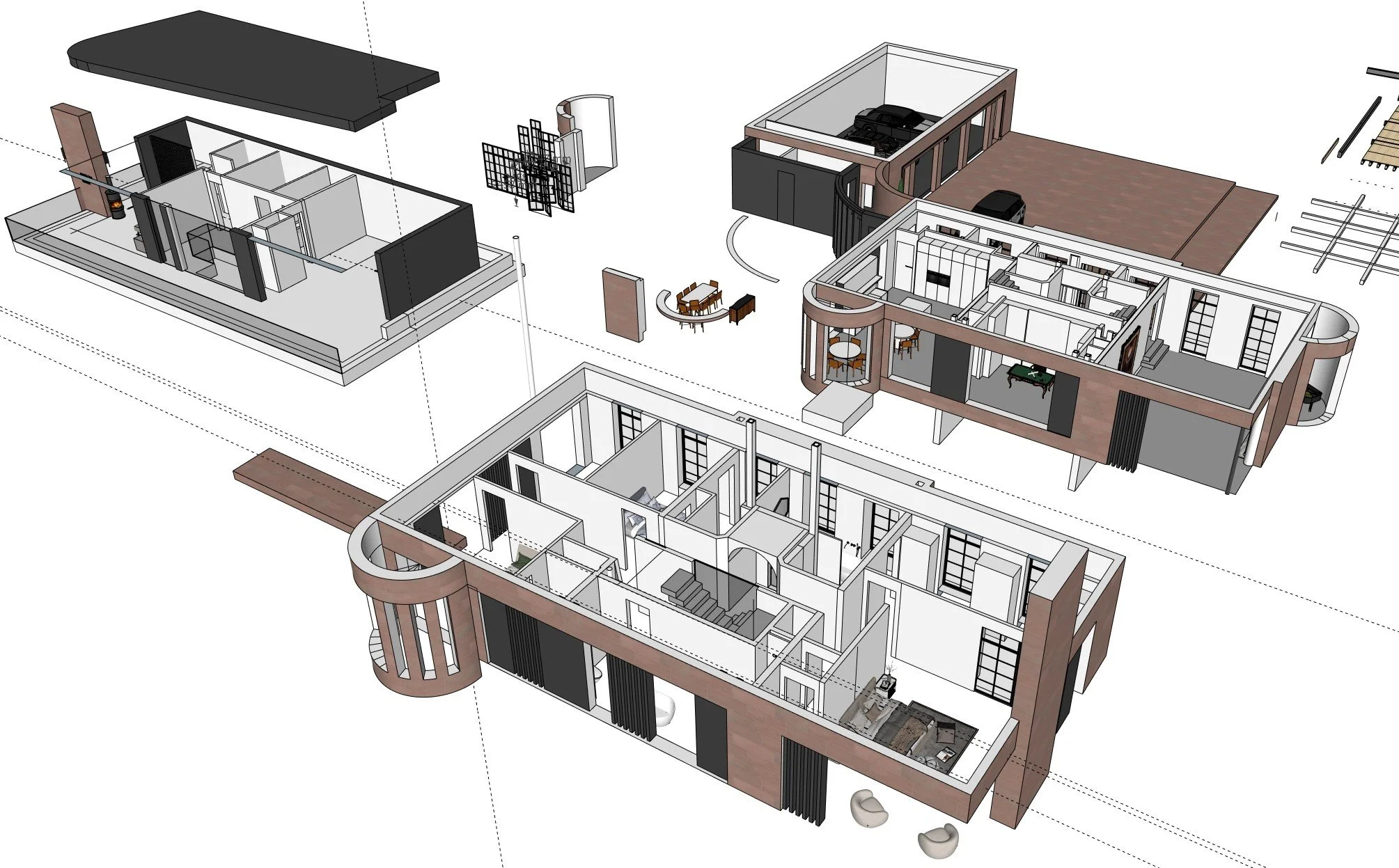
Each floor in dialogue, the whole picture unfolding through iteration.
Design doesn’t arrive fully formed for me. It emerges.
I rarely begin with a fixed idea of how something will look at the end. Instead, I start with a loose framework — a plan, a proportion, a circulation move — and allow the design to unfold as I work. Each decision informs the next, and often loops back to refine what came before.
This is an iterative, recursive process. I hold the whole picture and the smallest details at the same time, constantly sensing how a single change — a stair width, a landing position, a shift in alignment — affects everything else. When something is off, I feel it immediately. And until it’s resolved, I can’t quite settle.
Designing this way means working across multiple fields simultaneously: technical, functional, spatial, material, emotional. Light, movement, proportion, and use are all being tested together, not in isolation. It isn’t top‑down or bottom‑up thinking — it’s inside‑out design.
It makes no sense to me to design a house and then try to make the internal spaces fit the client’s requirements. For example, why propose a space for a kitchen only to later realise that a window or a stair needs to move, resulting in the design being compromised? Instead, the whole design should evolve together. With a broad understanding of how the house and its rooms will function, decisions about proportions, light, circulation, and layout are made in parallel. The finer details are refined as the process unfolds. It’s evolution in design — considered, recursive, and holistic.
Ideas don’t arrive first and get executed later. They form through making. A basic floor plan leads to a stair adjustment, which reveals a better room relationship, which unlocks a clearer structure. One thing leads to another, much like building something complex without instructions — responding in real time to what the design is asking for.
This way of working is demanding. It requires sustained focus and a willingness to revisit decisions again and again. But it’s also how spaces become resolved rather than simply assembled. When it works, the design quietens. The questions stop. Movement feels natural. Nothing is fighting for attention.
That moment — when the space settles — is what I’m always working towards.
It’s not about adding more. It’s about iterating until what remains feels inevitable.